

The Four Building Blocks of Transformation
If you are a business leader, you are probably thinking about radical change. New industrial platforms, geopolitical shifts, global competition, and changing consumer demand are reshaping your world. You face upstart competitors with high valuations encroaching on your business, and activist investors looking for targets. Meanwhile, you have your own aspirations for your company: to be a profitable innovator, to seize opportunities, to lead and dominate your industry, to attract highly committed talent, and to carve out a socially responsible role in which your organization makes a difference. You also probably want to clear away the deadwood in your legacy system: practices, structures, technologies, and cultural habits that hold your company back.
The conventional response is a transformation initiative — a top-down restructuring, accompanied by across-the-board cost cutting, a technological reboot, and some reengineering. Maybe you’ve been through a few such initiatives. If so, you know firsthand how difficult it is for them to succeed. These efforts tend to come in late and over budget, leaving the organization fatigued, demoralized, and not much changed. They don’t take into account the fundamentally new kinds of leverage available to businesses that have emerged in the last 10 years: new networks, new data gathering and analysis resources, and new ways of codifying knowledge (see “Leading a Bionic Transformation,” by Miles Everson, John Sviokla, and Kelly Barnes).
Successful transformations may be relatively rare, but they do exist — and yours can succeed as well. A transformation, in this context, is a major shift in an organization’s capabilities and identity so that it can deliver valuable results, relevant to its purpose, that it couldn’t master before. It doesn’t necessarily involve a single major initiative (though it could); but the company develops an ongoing mastery of change, in which adaptability feels natural to leaders and employees.
An effort of this sort can take place on a large or small scale; it can involve the front, middle, or back office; it can be conducted by any type of enterprise, from a startup to a global enterprise; and it will affect every aspect of the organization’s structure, including such functions as innovation, finance, marketing, sales, human resources, and operations. At any scale, it requires a cultural shift and highly engaged leaders, who take control of the organization’s future in these four ways:
• Create a strategic identity. Articulate a single desirable future for your enterprise and focus all your efforts on achieving it.
• Design for trust. Develop ways to attract and deserve the commitment of everyone related to your enterprise — particularly customers and employees.
• Master the pivot from sprint to scale. Test new practices in an intensive, experimental, startup-style manner. Pick the approaches that work, and rapidly implement them throughout the larger system.
• Treat your legacy as an asset. Save the best of your past, divest the rest for advantage, and use the income to fund the future.
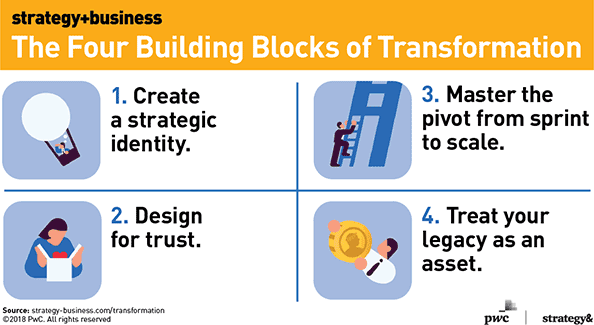
We think of these as the basic building blocks of any successful transformation. They aren’t specific steps, stages, or organizational designs. Those will vary from one enterprise to the next. Rather, they are ways of thinking about influence and change: perspectives on how to shift organizational and individual behavior in a more productive, competitive, and engaging direction.
We identified these elements through a comprehensive research and synthesis project that took place early in 2018. We convened a broad, global group of PwC’s most knowledgeable experts on organizational change, particularly change at the nexus of business strategy, customer experience design, and advanced digital technology. At an extended in-depth session with 35 members of this group, we studied examples of successful transformations and articulated the factors common to them. Then we tested our findings in follow-up research and discussions with other experts, inside and outside PwC, and with clients. Though the cases varied widely — by region, industry, circumstance, and personality — the four building blocks were consistently pivotal to success. The transformation initiatives we studied (described here and included in our library of case studies on the PwC website) have helped companies shake free of their self-imposed shackles, adopt dynamic new business models, and raise their game in a swiftly changing world.
Create a Strategic Identity
Every company today needs to make a distinctive mark. This is a matter of building not just a brand, but a powerful identity, in which the company’s value proposition, core capabilities, customer and employee experience, and culture all reinforce one another. Companies with a fully coherent, differentiated, strategic identity — the likes of Apple, IKEA, Starbucks, and Honda — become iconic. They make an absolute commitment to a single overarching way of doing business, and to a grand vision of the company they need to be. Sean Connolly, president and CEO of Conagra Brands, offered his view about this sort of organizational change in a 2016 interview with the Chicago Tribune: “[It] is not for the faint of heart.”
At the time of that interview, Conagra was still in the early stages of its celebrated transformation — from a diffuse, US$18 billion conglomerate of agricultural and food-related businesses (described in the press as a potential takeover target) to a focused $8 billion purveyor of consumer food brands in North America. Connolly had been hired in April 2015 after serving as the CEO of Hillshire Brands. At Conagra he was charged with refocusing the company’s mission and turning it around. That mandate intensified a few months later, when the activist hedge fund Jana Partners bought a stake in Conagra and gained two seats on its board.
On the most practical level, Conagra’s transformation initiative involved deals and structural moves: selling a private-label business, spinning off a vertically integrated potato business, relocating headquarters, resetting the cost structure, acquiring contemporary brands, realigning its operating model, eliminating unprofitable legacy practices (including the indiscriminate use of discount promotions), and changing the company name from ConAgra Foods to Conagra Brands. At the heart of all this activity was a new concept of the company’s identity:
A nimble innovator, with (according to its vision statement) “the most energized, highest-impact culture” in the food industry. Conagra’s brands would now be required to be the first or second in their sector, and to be known for attracting highly loyal followers (for example, Hunt’s, Peter Pan, Orville Redenbacher’s, Reddi-wip, Slim Jim), defining a prepared food niche (Bertolli, Hebrew National, Marie Callender’s), or emphasizing quality ingredients and health (Alexia, Blake’s, Frontera, Healthy Choice). “This is a totally new era,” Connolly told stock analysts in October 2016.
“We are not the ag business that we started as almost 100 years ago. We are certainly not the global conglomerate that we’ve been for decades. For the first time in our history, we will be a branded CPG pure play.”
The related new body of operations practices, dubbed the “Conagra Way,” was modeled after smaller, more flexible companies. The new IT system, built on a cloud-based infrastructure, was oriented toward rapid innovation and communication across internal silos. “Where there is friction [in the digital infrastructure], there is opportunity,” CIO Mindy Simon told CIO Magazine. “How can we use analytics to help our chefs develop new products? How can we use sensors to improve our distribution?”
The results include more than $300 million in annual savings and quick growth in financial metrics, including more than 40 percent growth in total shareholder return between May 2015 and May 2017. Employees and retailers describe Conagra Brands as an entirely different company. And its 2018 acquisition (for $10.9 billion) of Pinnacle Foods (with brands such as Birds Eye, Gardein, EVOL, and Smart Balance) makes Conagra the second-largest frozen food company in the U.S., after Nestlé. The Conagra story shows how a well-considered shift in identity can take hold in even the largest and most established companies.
As you take on the mind-set of an upstart, and articulate a bold new vision to establish your company’s new identity, keep these precepts in mind:
Tell a good story. All too often, the leaders of a transforming company use dry, technocratic language to explain the change and its rationale. But in a successful effort, the business leader sets the tone by translating the company’s new strategic identity into vivid, everyday language — so that everyone can see how their jobs contribute, and why each part of the change matters.
This may well mean articulating a company purpose that goes beyond making money. Employees and customers understand that enterprises are powerful, and that they exist to achieve something with that power — connecting people, producing wealth, creating products and services, or bringing new forms of value to society. When there is a clear, evocative statement of how the company creates value, not just for the shareholders and owners but for the greater world around it, employees feel a connection with the new identity. They understand how it will help them prosper and make them proud to be associated with it.
Use symbolic gestures to represent this clarity of purpose and bring the identity to life. For example, Conagra consolidated all its Chicago-area suburban offices into one downtown building to attract talent, create a high-energy collaborative environment, and accelerate decision making. Connolly explained it this way: “[We can] see each other in the hallway, and get business done in five minutes, rather than on a conference call five days later. Everything [is] recharged.”